"Conflicting views about the treatment of Germany were a major cause of the Cold War." To what extent do you agree with this statement? (May 2012)
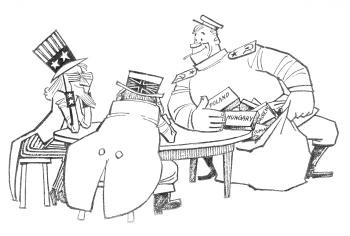
The cartoon was published in the Manchester Daily Dispatch on 18 March 1946, and was drawn by the British cartoonist George Butterworth. It was inspired by Churchill's Fulton speech (5 March 1946) and reflects a counter-argument to that of the question regarding the causes of the Cold War. It does however, provide useful support for the assertion that the Cold War was 'established' by March 1946.
In this essay, you are expected to support the assertion in the question, but the command term "to what extent" is of vital importance because this signals that you are expected to prove your conclusion against alternative hypotheses. The question should not be treated as a simple analysis of the causes of the Cold War. Instead, it should assess the differing views as to the importance of Germany.
The views of the US
The US had a desire to rebuild the German economy and reunite Germany as a nation and this was demonstrated by the disagreement over reparations at Potsdam; the Byrnes speech in 1946 which supported a rebuilt German economy; Marshall Plan aid and currency changes in 1948. In addition, the decision to unify the three western zones into Bizonia and then Trizonia was a clear statement that the US wanted a strong and economically powerful Germany to assist US trade and to act as a bulwark against communism. The decision to create the Federal German Republic and to rearm Germany after 1951, and to allow them to join NATO in 1955, were all indicative of American support for German rebuilding and the lack of fear of a strong Germany. These actions caused fear and apprehension in the USSR, which felt that Germany might be used to launch an attack on the Soviet territories in Eastern Europe or the USSR itself. Such actions were also seen as an indication of possible US imperial motives in Europe.
The views of the USSR
The USSR demanded huge reparations both to weaken the German economy and help Soviet post-war recovery. The USSR did not wish to encourage German development and refused Marshall Aid for East Germany. It was clear that the USSR wanted Germany to remain poor and neutral to prevent another attack and, perhaps, to create conditions for a possible Communist takeover. These actions increased Western fears of further Soviet expansion in Europe. The Berlin blockade was seen as an example of Soviet aggression and hardened Western attitudes toward the USSR, leading to the formation of NATO and the further division of Europe into rival blocs.